TradingKey - Microsoft began September with a commanding position amongst the large-cap AI stocks. MSFT closed NYSE trade routes on August 28 at about $513.53, nearly at the $513.86 reference chart level, after extending its win streak to six trading days. The stock also cleared a resistance zone. Fundamentals also look good with Azure, Copilot, and a growing backlog of strong commercial deals. The main question with MSFT is, where do you think this run extends to. There's the potential for a test at the $523.08 Fibonacci extension.
Azure Reacceleration Strengthens the AI Monetization Case
In the last quarter of FY 2026, Microsoft reported total revenues of $90.0 billion, an increase of 18% compared to last year, while the operating income stood at $40.6 billion. In terms of segment performance, Azure and other services revenue grew at 43% (from 40% in the preceding quarter), and the Microsoft Cloud stood at $59.3 billion, an increase of 27%.
Commercial remaining performance obligations (RPO) increased to $678 billion, an increase of 84% from the corresponding period last year. That backlog provides the Company a good outlook on enterprise revenues, confirming the demand for AI infrastructure.
For GAAP EPS, it stood at $4.81. Microsoft also reported several discrete items, such as a $3.2 billion gain from its investment in Anthropic. After adjusting for the OpenAI investment, the Anthropic gain was one of several discrete items affecting the quarter. Strong performance of Azure continues to be important.
Copilot and Agent Adoption Are Becoming Material
With more than 30 million paid seats, Copilot is seeing healthy growth. The company reports net paid-seat additions more than doubling quarter over quarter. Just two months ago, Agent 365 was launched and already has nearly 40 million agents registered with tens of thousands of companies. Meanwhile, Microsoft Foundry boasts more than 100,000 customers with revenue that more than doubled year over year.
With Microsoft’s AI strategy moving beyond infrastructure, the addition of Copilot, Foundry, and enterprise agents, together with Azure, provide the compute layer and extend opportunities for higher-margin software.
Maia 300 Could Improve AI Economics
The best catalyst event for September is likely the addition of Maia 300- powerful microchips that help Microsoft improve AI Economics. While strict numbers have not been released, Reuters reported that Microsoft could unveil Maia 300 as early as September 2026 and is discussing TSMC production capacity for more than 300,000 chips for delivery in 2027. As of now, the numbers have not been made official by Microsoft, so they should not be considered part of the company's official goals.
While it doesn’t stop Microsoft from buying NVIDIA and AMD supplies, the introduction of proprietary chips helps improve economics of inference, supply stability, and control over costs. According to management, Maia 200 is more than 30% better in performance per dollar than the latest-generation hardware in Microsoft’s fleet.
Capacity Expansion Is Working, but Margins Are Under Pressure
Microsoft added an additional gigawatt of data center capacity in their fiscal Q4. This brings them on track to double their data center capacity in the next two fiscal years. Meanwhile, processing workloads through the AI copilot has increased fourfold since the start of the year.
This increased investment is beginning to show up in their financial statements. Microsoft Cloud gross margin dropped to 65% in fiscal Q4 compared to 68% the year prior. Investors assuming a longer-term view are confident that high utilization and increased monetization of software services will offset the costs of increased data center capacity along with improved custom silicon.
Microsoft has also reported $329.1 billion in future uncommenced data center leases, per Reuters. These are not conventional debts, but they are material obligations that reinforce the importance of growing Azure and Copilot.
India Adds Another Cloud Growth Engine
Microsoft opened their South Central Cloud region of India in Hyderabad on August 6. This is their 4th cloud region of India and up from their previous hyperscale investments in India. Early customers include the Adani Group, HDFC Bank, Bajaj Finserv, and PB Pay.
India’s developer base, strong enterprise cloud demand, and increasing AI adoption make this region an excellent choice for Microsoft’s approximately $20.5 billion investment and another geographic growth engine.
Microsoft Technical Analysis: $523.08 Is the Next Target
The stock price at $513.86 as shown in the provided 4-hour chart is almost at the end of day trading at $513.53 on August 28. Breaking through the resistance zone of $499 to $500 and the previous swing high of $513.14 strengthens the overall bullish tendency of the stock.
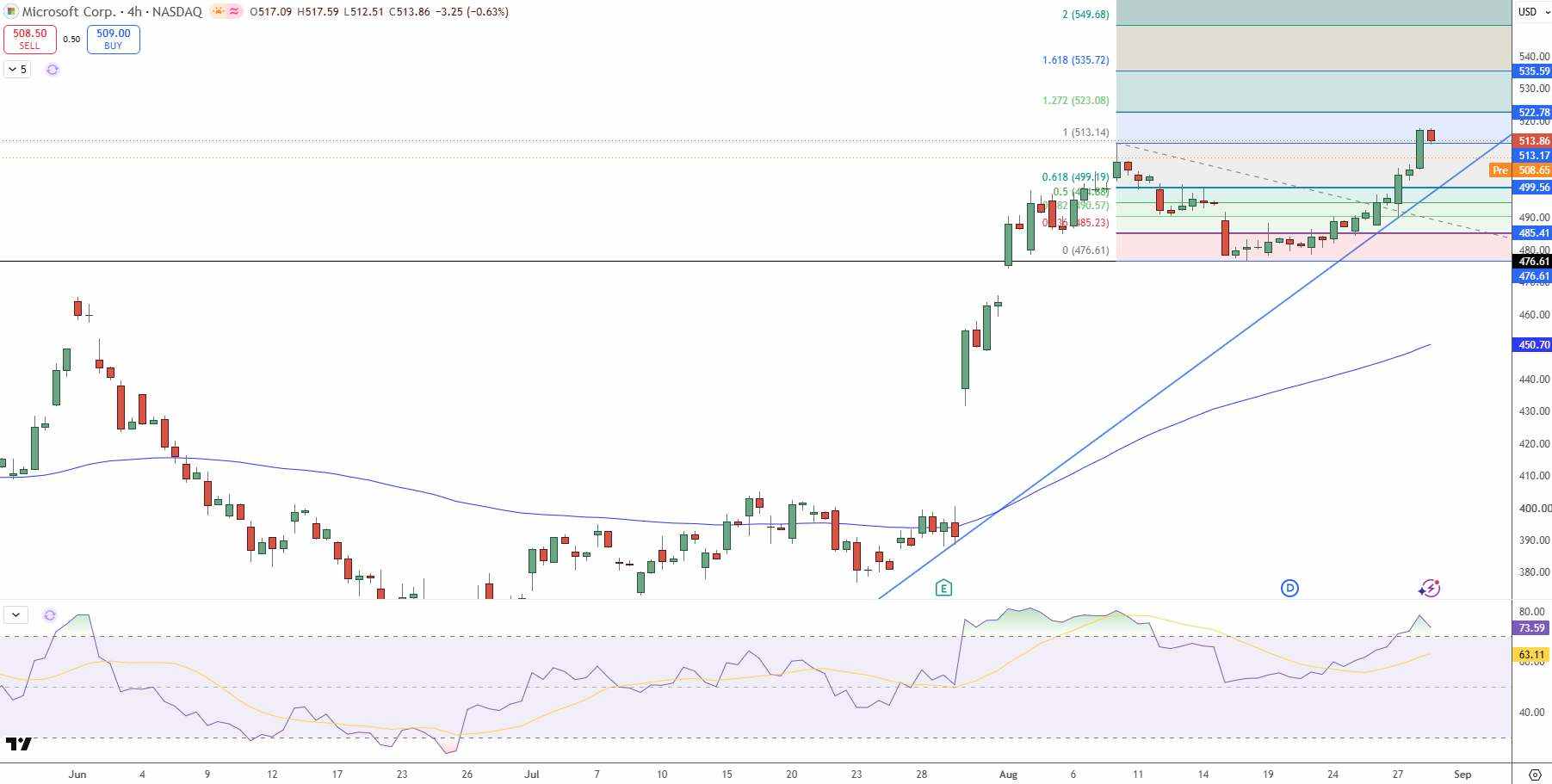
Microsoft Stock Price Chart - Source: Tradingview
If buyers continue to accept prices at $513.14 - $513.86, next, the market is likely to test the 1.272 Fibonacci extension level of $523.08. Beyond that, the market will test levels of $535.72 and $549.68.
While the RSI is above 70, and at 74, it is indicative of momentum. However, price is considered stretched and is therefore at a high probability of consolidation or breakout retracement. The new support zone is at $499.19 - $499.56. A pull back to that area would negatively affect the bullish structure if the support break that triggered the move is closed by trade below that level. Deeper support levels are at $490.57 and $485.23.
Key Levels
· Most recent completed close: $513.53
· Breakout zone: $513.14 - $513.86
· First bullish target: $523.08
· Upper targets: $535.72 and $549.68
· Major support: $499.19 - $499.56
· Additional support: $490.57 and $485.23
· RSI: 74, overbought
Why is Microsoft stock strengthening?
Microsoft has positively trending growth in Azure, additional rapid Copilot usage, and anticipated AI spending that could generate income for the enterprise.
Is MSFT overbought after the breakout?
Yes. At 74, MSFT is in overbought territory. It is unlikely to affect the bull trend, but it could lead to a consolidation or retest of the $499 breakout zone before an upward trend.
Bottom Line
Microsoft begins the month of September with a significant positive indication that AI spending leads to cloud growth and increases software demand in enterprises. In combination with growth in Azure (43%), Copilot reaching 30 million paid seats and a total commercial backlog of $678 billion, there are clear and present risks: pressure on cloud margin, an immense data center commitment and overbought stock. MSFT is bullish as long as it stays above $499. A clear break of $513 would encourage a move to $523 and $535.
Find out more